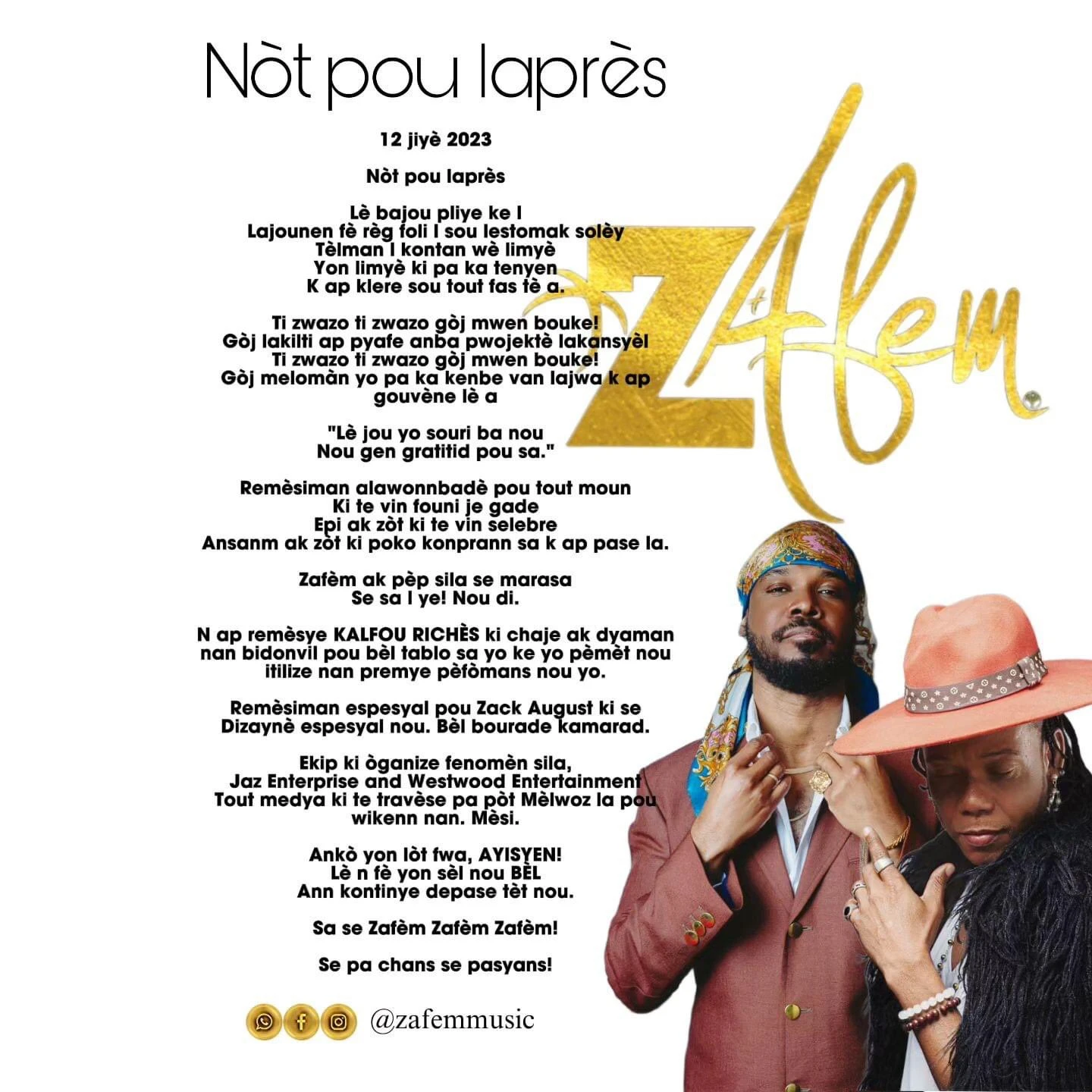
The release of the album Las by the band Zafem marked a significant turning point in modern Haitian music. Among the sixteen tracks that captivated audiences worldwide, “Bradsou Bradsa” stands out as a profound ballad of solidarity and enduring affection.
Sung by the prolific songwriter and maestro Dener Ceide, the track transcends the typical boundaries of a love song to explore themes of destiny and existential balance.
Listeners are drawn not only to the melodic sophistication of the track but also to its rich lyrical content. The song weaves together personal vulnerability with deep-rooted cultural metaphors, presenting a relationship that survives through mutual support rather than mere romance. It speaks to the reality of maintaining a connection through the inevitable trials of life.
This article provides a comprehensive analysis of “Bradsou Bradsa,” examining its musical composition, lyrical narrative, and the specific cultural symbols that give it weight. By dissecting the verses and the philosophy behind the music, we gain a clearer understanding of why this piece resonates so deeply with the Konpa audience.
The Musical Architecture of Zafem’s Ballad
Musically, “Bradsou Bradsa” is built upon the foundational rhythms of Konpa Dirèk but is elevated by complex harmonic structures. Dener Ceide, known for his virtuosity on the guitar, constructs a melody that is both soothing and melancholic.
The arrangement avoids the high-tempo aggression of carnival music, opting instead for a “Gouyad” influence—a slower, more sensual rhythmic style that emphasizes the groove over speed.
The instrumentation serves the storytelling. The interplay between the keyboards and the guitar creates a conversation that mirrors the dialogue in the lyrics. The percussion is steady and grounded, symbolizing the heartbeat of the relationship described in the text. This sonic backdrop allows the vocals to take center stage, ensuring that every word of the narrative is heard and felt by the listener.
Critics and fans alike have noted the production quality, which blends contemporary studio techniques with traditional Haitian aesthetics. This fusion creates a timeless sound, making the song feel like a classic standard despite being a modern release. It demonstrates the band’s commitment to evolving the genre while respecting its roots.
Deciphering the Title: The Meaning of Bradsou Bradsa
The phrase “Bradsou Bradsa” literally translates from Haitian Creole to “arm in arm.” However, in the context of the song, it signifies much more than a physical posture. It represents a state of total solidarity and structural support between two people.
Walking “bradsou bradsa” implies facing the world as a united front, physically linking bodies to prevent one another from falling.
This imagery is central to the song’s message of resilience. The lyrics suggest that the couple is not merely walking side by side but is interlocked. This interlocking provides stability when the “road of love” becomes difficult or uneven. It is a visual metaphor for a partnership that functions as a single, sturdy entity against external pressures.
By choosing this title, Zafem emphasizes that true love is active participation. It requires the physical and emotional effort of holding on to one another. The repetition of the phrase in the chorus acts as a mantra of commitment, reinforcing the idea that separation is not an option for those who are truly linked.
Lyrical Analysis: The Broken Lines of Love
One of the most striking aspects of the song is its refusal to idealize romance. The narrator explicitly acknowledges that the journey is fraught with challenges. The line mentioning “wout lanmou plen ling brize” (the road of love is full of broken lines) suggests that the path is rarely straight or smooth. It is a candid admission that confusion, arguments, and doubts are natural parts of the human experience.

The song opens with a dialogue where the partner is seeking reassurance. They question the narrator’s feelings and perceive changes in their behavior. Instead of dismissing these concerns, the narrator validates the bond. They use the metaphor of a “radio station” to describe their heart, assuring the partner that the frequency—their core personality and love—has not changed.
This section of the song highlights the importance of communication. The narrator admits to moments of weakness where they considered stopping, yet a “little voice” urged them to continue. This honesty creates a relatable narrative for listeners who understand that long-term commitment often requires choosing to stay even when emotions fluctuate.
Cultural Symbolism: The Concept of Marasa
Towards the climax of the song, Dener Ceide introduces the concept of “Marasa.” In Haitian culture and spiritual traditions, Marasa refers to the sacred twins. They represent the fundamental duality of the universe: male and female, flesh and spirit, human and divine. The Marasa are symbols of perfect balance, abundance, and the multiplication of blessings.
By declaring “nou se marasa” (we are marasa), the songwriter elevates the relationship to a spiritual plane. It suggests that the two individuals are not just partners but are two halves of a cosmic whole. In cultural belief, twins share a soul and a destiny that cannot be severed without great consequence.
This reference deepens the meaning of the song significantly. It moves the narrative from a simple romantic struggle to a destined connection. The invocation of this symbol implies that their union is blessed and necessary for their mutual survival. It frames their reconciliation not just as a choice, but as an alignment with a higher order of balance.
Dener Ceide’s Songwriting Techniques
Dener Ceide is widely recognized as one of the most sophisticated songwriters in the Caribbean. His technique in “Bradsou Bradsa” involves a careful blend of colloquial speech and poetic elevation. He uses everyday phrases like “babye” (to pout or complain) to ground the song in reality, making the characters feel like real people with relatable flaws.
Simultaneously, he employs high-concept metaphors involving the sun and the radio. This juxtaposition of the mundane and the majestic is a hallmark of his style. It allows the song to be accessible to the general public while offering layers of meaning for those who wish to analyze the text more closely.
The structure of the song also reflects a journey. It begins with questioning, moves through reassurance and admission of fault, and ends with a declaration of identity (Marasa). This narrative arc provides a satisfying emotional resolution for the listener, reinforcing the theme that they have “fèk kare” (just begun) their journey together.
Full Lyrics and Contextual Translation
Understanding the lyrics in their original Creole helps capture the emotional nuance of the performance. Below are key sections of the song with context regarding their translation and sentiment.

Verse 1: The Inquiry
“G’on kesyon’w renmen poze’m… Ou vle pou m babye babye ba w”
The partner frequently asks questions, seeking explanations. The singer notes that the partner seems to want a reaction, perhaps even a disagreement, to feel the engagement of the relationship.
Chorus: The Mission
“Mwen ak ou gen men’m misyon… Anyen pap janm kapab separe’n”
Here, the singer defines the relationship as a “mission.” This word choice implies a job or a duty that must be completed. It asserts that nothing can separate them because their purpose is intertwined.
Bridge: The Reassurance
“Pòs radyo sa’m pap chanje’l… Ou pa bezween ebranle”
The “radio station” metaphor appears here. The singer tells the partner not to be shaken (ebranle), promising that the source of the music—their heart—remains tuned to the same frequency.
Outro: The Spiritual Bond
“Solèy nan kè n ka briye nou se marasa se sa n ye”
The sun shines in their hearts; they are Marasa. This is the final affirmation of their identity as a dual entity, full of light and indivisible.
FAQ
What is the literal meaning of “Bradsou Bradsa”?
In Haitian Creole, “Bradsou Bradsa” translates to “arm in arm.” It describes the physical action of two people linking arms. Metaphorically, it signifies solidarity, mutual support, and facing life’s challenges as a united front.
Who are the members of the band Zafem?
Zafem is fronted by two prominent figures in the Haitian music industry: Dener Ceide and Réginald Cangé. Dener Ceide is a celebrated songwriter, producer, and guitarist, while Réginald Cangé is renowned for his powerful vocal range and stage presence. “Bradsou Bradsa” is primarily performed by Dener Ceide.
What is the significance of the term “Marasa” in the song?
“Marasa” refers to the sacred twins in Haitian cultural and spiritual traditions. They symbolize duality, balance, and the union of opposites. By using this term, the songwriter suggests the couple shares a profound, almost predestined connection that goes beyond simple romance.
Which album features the song “Bradsou Bradsa”?
The song is featured on Zafem’s debut studio album titled Las. The album was released in May 2023 and quickly garnered critical acclaim for its sophisticated arrangements and lyrical depth.
What genre of music is “Bradsou Bradsa”?
The song falls under the genre of Konpa (or Compas), which is the modern meringue dance music of Haiti. Specifically, it leans toward a “Gouyad” style, which is a slower, groovier sub-genre of Konpa focused on sensual rhythm and melody.
What does the “radio station” metaphor mean in the lyrics?
In the lyrics, the singer tells his partner, “Pòs radyo sa’m pap chanje’l” (I won’t change this radio station). This is a metaphor for his heart and personality. He is reassuring his partner that despite her fears, his core self and his feelings for her remain constant and tuned to their relationship.