In the landscape of the Haitian Music Industry (HMI), few events have generated as much anticipation and subsequent analysis as the grand premiere of the band Zafèm. The debut performance, held at the Melrose Ballroom in New York, was not merely a concert; it served as a cultural watershed moment that redefined the standards of live Konpa performance.
Led by the virtuoso Dener Ceide and the charismatic vocalist Réginald Cangé, the event transcended entertainment to become a celebration of heritage, resilience, and collective identity.
The imagery surrounding the event was carefully curated to reflect themes of rebirth and endurance. Observers and critics alike noted the poetic symbolism employed by the band, likening their arrival to the calm of dawn—a moment of quiet power before the sun fully illuminates the world.
This premiere represented the culmination of years of musical evolution, bringing together a diaspora hungry for a sound that honored tradition while embracing modern sophistication.
This article explores the profound cultural significance of Zafèm’s premiere, dissecting the lyrical metaphors, the spiritual undertones of the performance, and the technical artistry that made the night historic. From the concept of “Marasa” to the visual storytelling of “Kalfou Richès,” we examine how this event solidified the band’s place in the pantheon of Caribbean music legends.
The Symbolism of the Bamboo and the Rising Sun
Central to the narrative of Zafèm’s debut is the metaphor of the bamboo. In Haitian folklore and proverbs, bamboo is revered for its ability to bend without breaking, symbolizing humility and resilience in the face of adversity. The band utilized this imagery to describe their journey to the stage. Just as bamboo seeks the warmth of the sun after a cold night, the band positioned their premiere as a moment of seeking connection with their audience after a long period of preparation and anticipation.
The “sun” in this context represents the public—the source of energy and validation for any artist. The premiere was described as an event as radiant and pervasive as sunlight, enveloping the venue and the global audience tuning in via livestreams.
This interplay between the humble artist (bamboo) and the life-giving audience (sun) set a tone of mutual respect and gratitude that permeated the entire evening.
This metaphorical framework elevated the concert beyond a commercial endeavor. It framed the performance as a natural phenomenon, inevitable and vital. By grounding their debut in elements of nature, Zafèm connected their modern sound to the timeless rhythms of the earth, suggesting that their music is as organic and necessary as the dawn itself.
Deciphering the Cry: “Ti Zwazo Gòj Mwen Bouke”
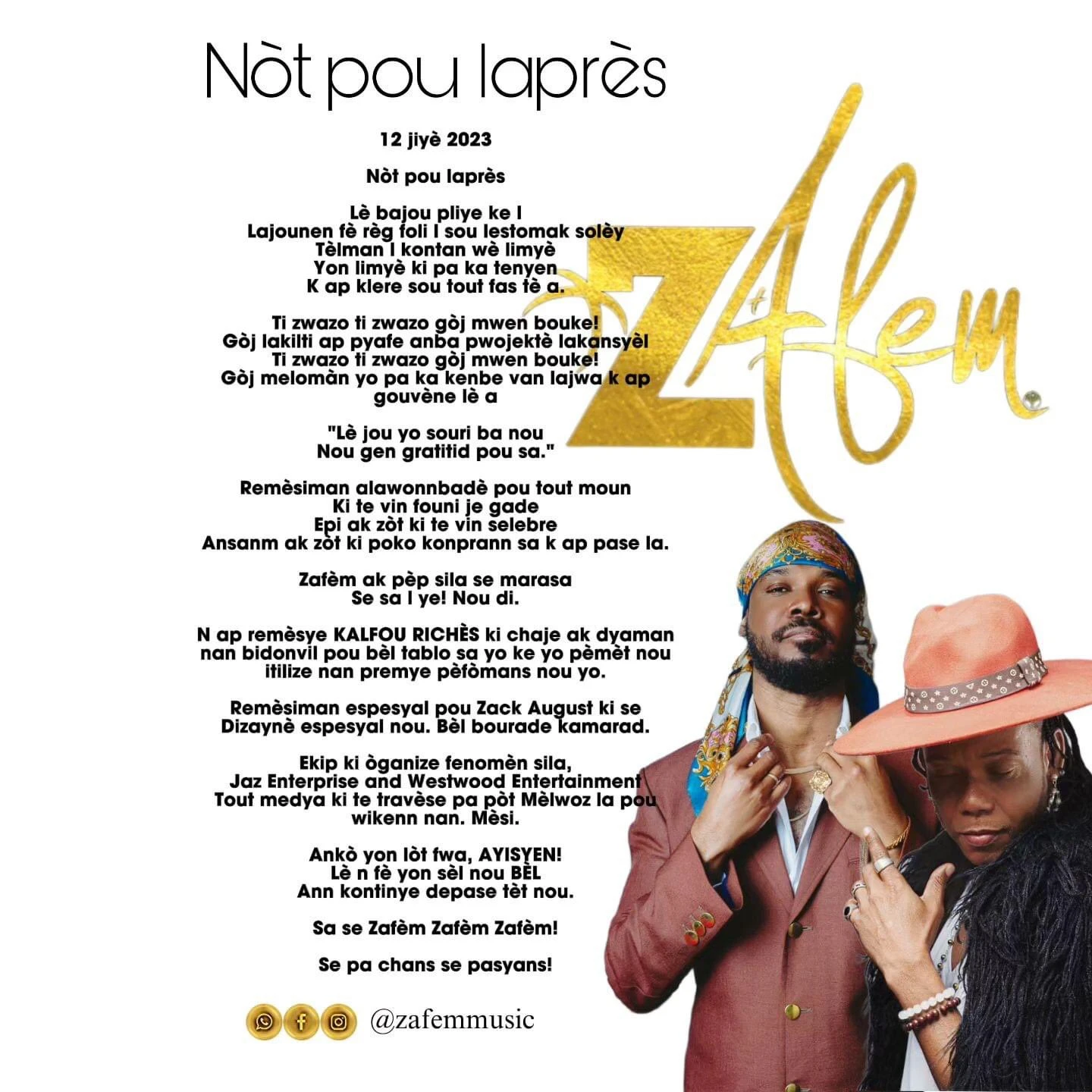
During the performance, the phrase “Ti zwazo, ti zwazo gòj mwen bouke” (“Little bird, little bird, my throat is tired”) resonated deeply with the crowd. On the surface, this line speaks to the physical exertion of singing, but culturally, it carries a much heavier weight. It is a poetic expression of exhaustion born from struggle, a plea for relief, and a testament to the intensity of the emotion being poured out. In the context of the premiere, it symbolized the release of pent-up artistic energy.
The crowd’s reaction to these lyrics transformed the venue into a space of communal catharsis. The hum of the audience was compared to the vibrant dance of bees, a collective vibration that underscored the transformative power of the music. This was not passive listening; it was active participation. The audience became part of the composition, their cheers and responses filling the spaces between the notes.
This dynamic illustrates the unique relationship between Haitian artists and their fans. The “tired throat” is not a sign of weakness but a badge of honor, proving that the artist has given absolutely everything they have to the performance.
It is a moment of vulnerability that invites the audience to carry the song forward, creating a seamless loop of energy between the stage and the floor.
Gratitude as a Rhythmic Foundation
A recurring theme throughout the premiere and the band’s subsequent communications was the concept of gratitude. The phrase “Lè jou yo souri ba nou, Nou gen gratitid pou sa” (“When the days smile at us, we are grateful for that”) encapsulates a philosophy of mindfulness and appreciation.
In an industry often driven by competition and bravado, Zafèm chose to center their narrative on thankfulness for the moment and the community that made it possible.

This gratitude extended to every participant in the event, from the die-hard fans in the front row to those watching from afar who may not have fully grasped the magnitude of the history being made. The band acknowledged that a premiere of this scale is a collective achievement.
It requires the synchronization of logistics, technical skill, and emotional investment from thousands of people.
By publicly expressing this deep appreciation, the band reinforced the communal nature of Haitian social life. Success is rarely seen as an individual pursuit; it is a shared victory. The smiles, cheers, and applause were interpreted not just as reactions to the music, but as symbols of a unified spirit, acknowledging that the “day had smiled” on everyone present.
The Marasa Concept: Spiritual and Cultural Unity
One of the most profound cultural references made regarding the premiere is the comparison of the bond between Zafèm and their people to “Marasa.” In Haitian Vodou and cultural tradition, Marasa represents the sacred twins. They symbolize duality, balance, and an unbreakable connection that transcends the physical realm.
The Marasa are considered more powerful than other spirits because they represent the fundamental unity of opposites.
By invoking this concept, the band elevated their relationship with the audience to a spiritual level. It suggests that the artist and the listener are two halves of the same whole, inextricably linked. The premiere was not a performance for an audience, but a communion with them. This perspective shifts the dynamic from a transaction (ticket for entertainment) to a ritual of identity affirmation.
This bond of Marasa implies an infinite connection. The music serves as the medium through which this connection is maintained. When the band plays, they are mirroring the emotions and experiences of the people, and the people see themselves reflected in the artists. This deep cultural resonance is what distinguishes a legendary band from a merely popular one.
Kalfou Richès: Finding Beauty in Unexpected Places
The visual and thematic elements of the concert featured a concept referred to as “KALFOU RICHÈS” (Crossroads of Riches). This imagery symbolically depicts a crossroads overflowing with diamonds situated within the slums. It is a powerful commentary on the source of creativity and beauty. It asserts that the most precious cultural gems often originate from the most marginalized or humble environments.
This tribute to the “precious gems of the homeland” acknowledges the roots of Konpa music, which often emerge from the streets and the daily struggles of the Haitian people. The “Kalfou” is a significant symbol in Haitian culture, representing a place of decision, potential, and the meeting of different worlds.
By placing “riches” at this crossroads, the band honors the inherent value of their heritage, regardless of economic circumstances.
The production design utilized scenes that reflected this duality—the grit of reality mixed with the brilliance of artistic expression. It served as a visual reminder that the music is a refinement of raw experience, turning the hardships of life into something sparkling and valuable, much like diamonds found in the rough.
Visual Identity and Collaborative Mastery
The success of the grand premiere was also a triumph of visual identity and logistical planning. Special recognition was given to Zack August, the designer responsible for the band’s aesthetic presentation. In the modern music industry, the visual component is as critical as the sonic one. The camaraderie between the musicians and the design team highlighted a shared vision of excellence.
The event was organized by Jaz Enterprise and Westwood Entertainment, entities that managed the complex logistics of the Melrose Ballroom event. The smooth execution of such a high-profile concert requires military-grade precision. From sound engineering to security at the Melrose gates, the infrastructure supported the artistic vision, allowing the band to focus entirely on the performance.
The media also played a crucial role, traversing the gates to document the event. Their presence ensured that the narrative of the night was preserved and disseminated. The collaboration between the artists, the organizers, the designers, and the press created an ecosystem of success, proving that high-level execution is possible when different sectors of the industry work in harmony.

The Call for Unity: “Lè n fè yon sèl nou BEL”
Ultimately, the grand premiere served as a clarion call for unity among Haitians. The slogan “Lè n fè yon sèl nou BEL” (“When we are one, we are beautiful”) became the anthem of the night. This statement goes beyond aesthetics; it is a social and political affirmation. It suggests that beauty and strength are derivative of cohesion and solidarity.
Zafèm’s journey to this premiere was marked by patience rather than chance. They did not rush their debut; they waited until the product was refined and the timing was right. This patience was rewarded with a reception that unified various factions of the community. The event demonstrated that when the diaspora unites around a common cultural celebration, the result is a powerful display of national pride.
The mantra “This Is Zafèm” echoed not just as a band name, but as a declaration of identity. It signified ownership of the culture, the sound, and the moment. The premiere proved that music remains one of the most potent tools for binding a community together, surpassing oneself, and projecting a positive image of Haitian culture to the world.
FAQ
What is the significance of the “Marasa” reference in Zafèm’s music?
In Haitian culture, Marasa refers to sacred twins, representing duality, balance, and immense spiritual power. When Zafèm references Marasa, they are describing the unbreakable, twin-like bond between the band and their audience. It suggests that the artists and the fans are reflections of one another, creating a unified spiritual and emotional experience during performances.
Who are the key figures behind the band Zafèm?
Zafèm was formed by two heavyweights of the Haitian Music Industry: Dener Ceide and Réginald Cangé. Dener Ceide is widely recognized as a prolific composer, guitarist, and producer who has shaped the sound of modern Konpa. Réginald Cangé is a celebrated vocalist known for his powerful range and emotional delivery. Their collaboration represents a “supergroup” formation that generated immense anticipation prior to their premiere.
What does the phrase “Ti zwazo gòj mwen bouke” mean in this context?
Literally translating to “Little bird, my throat is tired,” this phrase is a poetic metaphor for the exhaustion that comes from deep, emotional exertion. In the context of the concert, it signifies the artist giving every ounce of their energy to the performance, to the point of physical depletion.
It represents a cathartic release of emotion that the audience shares and understands.
What is the concept of “Kalfou Richès”?
“Kalfou Richès” translates to “Crossroads of Riches.” It is a symbolic concept used by the band to describe finding value and beauty in unexpected or marginalized places, such as the slums. It highlights the idea that cultural diamonds—talent, art, and resilience—often emerge from difficult environments.
The band uses this imagery to honor their roots and the raw creativity of the Haitian people.
Why was the Melrose Ballroom premiere considered historic?
The premiere at Melrose Ballroom was considered historic because it marked the official live debut of a band that had already achieved legendary status through their studio recordings alone. The event was seen as a shift in the standard for HMI (Haitian Music Industry) productions, featuring high-level sound engineering, lighting, and stage design.
It was a sold-out event that demonstrated the commercial and cultural viability of high-concept Konpa music.
How does Zafèm approach the theme of unity?
Zafèm promotes unity through the slogan “Lè n fè yon sèl nou BEL” (When we are one, we are beautiful). They position their music as a gathering point for the diaspora, encouraging Haitians to look past divisions and celebrate their shared heritage.
Their performances are designed to be inclusive events where the collective energy of the crowd is just as important as the music being played on stage.