Haitian music is a complex tapestry woven from African rhythms, European harmonies, and Caribbean storytelling. At the forefront of the modern evolution of this sound stands Dener Ceide, a musician whose influence stretches across generations and genres.
From his early days as a choir boy in the coastal town of Saint-Louis du Sud to his tenure with the legendary Tabou Combo, Ceide has consistently redefined what it means to be a Haitian artist. His journey is not just a biography of a singer but a roadmap of the Haitian Music Industry (HMI) itself.
Today, as the driving force behind the group Zafem, Ceide combines intellectual lyricism with infectious grooves. This article explores the technical, cultural, and personal milestones that transformed a young drummer into one of the most respected composers in the Caribbean.
Foundations in Saint-Louis du Sud
The musical identity of Dener Ceide was forged in the quiet, rhythmic environment of Saint-Louis du Sud. Unlike the chaotic bustle of the capital city, this coastal town offered a sonic landscape dominated by natural sounds and community traditions.
His earliest formal introduction to music came through the Catholic church, specifically the Notre Dame Alta Grâce. His mother served as the choir director, placing young Dener in the center of complex vocal arrangements from a very young age.
Choral music requires a deep understanding of harmony, blending, and dynamics. Listening to the soprano, alto, tenor, and bass lines interweave gave Ceide an intuitive grasp of musical structure long before he learned to read notes.
He often describes this period as his initial exposure to sound textures. The reverberation of voices within the church walls taught him how different tones color the atmosphere, a skill that would later define his sophisticated studio productions.
The Rhythms of Rara and Traditional Percussion
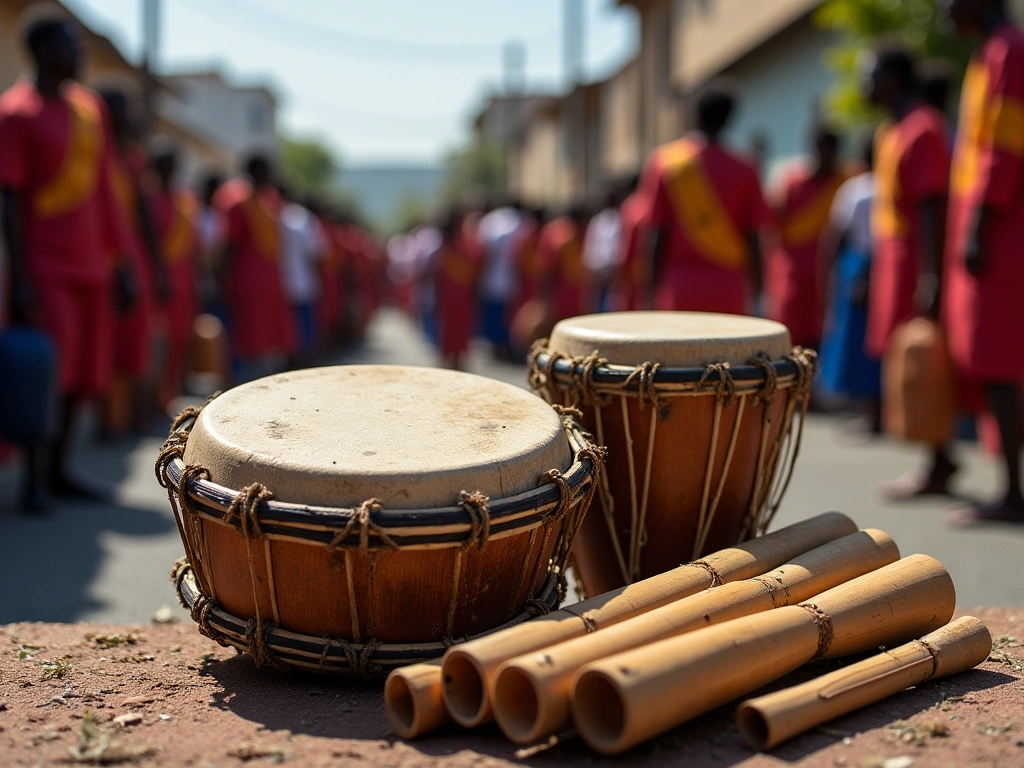
While the church provided harmonic discipline, the streets of Haiti provided the rhythmic engine. Ceide became fascinated by Rara, a form of festival music used for street processions, typically performed during the Lenten season.
Rara music is characterized by the use of cylindrical bamboo trumpets called vaksen and a variety of percussion instruments. The polyrhythms created by these ensembles are complex, often featuring interlocking patterns that require precision and stamina.
In the evenings, the sound of distant drum circles would drift into his home. These rhythms, deeply rooted in the island’s history, resonated with him on a visceral level, prompting him to explore percussion.
He began learning hand drumming, mastering instruments like the tanbou and the tchatcha (shakers). This percussive foundation is critical to understanding his later guitar work, which is often described as highly rhythmic and percussive in nature.
Transitioning to the Guitar
The pivot from percussion to melody occurred when Ceide was approximately ten years old. A performance at a local music camp by a visiting guitarist sparked an immediate realization that this was his intended instrument.
The guitar in Haitian music, particularly in the Compas Direct genre, acts as both a melodic and rhythmic tool. It often carries the “groove” in a way that drums do in other genres, requiring a technique that is both fluid and precise.
Ceide sought out Linné Edouard, a well-known local guitarist, to learn the basics. These lessons provided the technical framework, but Ceide’s obsession led him to practice hours a day, mimicking styles ranging from jazz to blues.

He began to understand the fretboard not just as a collection of notes, but as a vehicle for expression. This period of self-discovery allowed him to develop a unique “voice” on the instrument, blending the percussive attack of his drumming background with melodic phrasing.
The Miami Diaspora and Academic Growth
In 2000, Dener Ceide joined the large Haitian diaspora in Miami, Florida. This move was pivotal, as Miami serves as a major hub for the Haitian Music Industry, offering opportunities that were scarce in his hometown.
Recognizing that raw talent needed refinement, he enrolled at Miami Dade College to study music formally. This academic environment exposed him to music theory, jazz harmony, and advanced composition techniques.
Formal education bridged the gap between his intuitive ear and the mathematical realities of music. He learned to articulate why certain chord progressions worked and how to notate the complex rhythms he had grown up hearing.
During this time, he also networked with musicians from various cultural backgrounds, including Latin jazz players and American gospel artists. These interactions diversified his musical palette, allowing him to incorporate non-traditional elements into Haitian Compas.
The Tabou Combo Era
The ultimate test of Ceide’s abilities came in 2008 when he was invited to join Tabou Combo. Founded in 1968, Tabou Combo is arguably the most famous Haitian band internationally, known for filling stadiums from Paris to Panama.
Stepping into this role was a significant responsibility. The band’s repertoire spans decades and requires a guitarist who can navigate funk, meringue, and traditional Compas with equal proficiency.
Touring with Tabou Combo served as a masterclass in professionalism and stagecraft. Ceide learned the logistics of global touring, the importance of sound engineering, and how to manage the energy of a massive crowd.
His time with the band, which lasted until 2013, solidified his reputation as a top-tier musician. It also gave him the financial stability and industry connections necessary to eventually pursue his own creative vision.
The Architect Behind the Hits
While known as a performer, Dener Ceide’s impact is perhaps most profound as a songwriter and producer. After leaving Tabou Combo, he became the “secret weapon” for many of the industry’s biggest bands.
He penned and produced hits for heavyweights like Nu-Look, Klass, and Disip. In the HMI, the role of the composer is often overshadowed by the frontman, but Ceide’s signature sound became undeniable.
His compositions are noted for their lyrical depth and harmonic complexity. Unlike standard dance tracks that may rely on repetitive hooks, Ceide’s songs often feature narrative storytelling and sophisticated chord changes.
This era established him as a musical architect. He was no longer just playing the guitar; he was constructing the entire sonic landscape of modern Compas, influencing the direction of the genre from behind the scenes.
The Zafem Movement
The culmination of Ceide’s journey is the formation of his own group, Zafem, alongside fellow musician Réginald Cangé. Zafem represents a shift in the paradigm of Haitian dance music, prioritizing artistic integrity over commercial trends.
Zafem’s music is a deliberate blend of the old and the new. It incorporates the raw, energetic rhythms of traditional rasin (roots) music while utilizing modern production standards and jazz-influenced harmonies.
The band’s debut album was met with critical acclaim for its ability to make listeners think while they dance. The lyrics often touch on social issues, history, and Haitian identity, moving beyond the typical themes of romance found in Compas.
For Ceide, Zafem is the realization of a lifelong vision. It is the synthesis of the church choir harmonies, the Rara rhythms, the jazz theory, and the stadium rock energy he absorbed throughout his career.
FAQ
What is Dener Ceide best known for?
Dener Ceide is best known as a guitarist, singer, and songwriter in the Haitian Music Industry. He gained fame playing for the legendary band Tabou Combo and later co-founded the popular group Zafem. He is also a prolific producer who has written hits for numerous other top Haitian bands.
What is the musical style of Zafem?
Zafem plays a sophisticated style of Compas (Konpa) that integrates elements of traditional Haitian roots music, jazz, and funk. Their sound is characterized by complex arrangements, socially conscious lyrics, and high production value, distinguishing them from many contemporary dance bands.
Did Dener Ceide have formal music training?
Yes, after moving to the United States, Ceide attended Miami Dade College to study music. This formal education provided him with a strong foundation in music theory, harmony, and composition, which he combined with his self-taught skills to create his unique sound.
What instruments does Dener Ceide play?
His primary instrument is the guitar, on which he is considered a virtuoso. However, he began his musical journey playing percussion instruments like the tanbou and tchatcha. He is also a capable vocalist and keyboardist, allowing him to arrange full tracks in the studio.
Where is Dener Ceide from?
He was born and raised in Saint-Louis du Sud, a coastal town in the southern department of Haiti. His upbringing in this region heavily influenced his musical appreciation, exposing him to both Catholic choral traditions and local folk rhythms.
What is Compas music?
Compas (or Konpa) is the modern meringue dance music of Haiti. It was popularized in the 1950s and is defined by a consistent, pulsating rhythm often driven by the cowbell, tanbou, and guitar. It is the dominant popular music genre in Haiti and its diaspora.
Why did Dener Ceide leave Tabou Combo?
Ceide left Tabou Combo around 2013 to focus more on music production and songwriting. While he enjoyed touring, he wanted to develop his own creative voice and work with various artists, eventually leading to the creation of his own band, Zafem.